

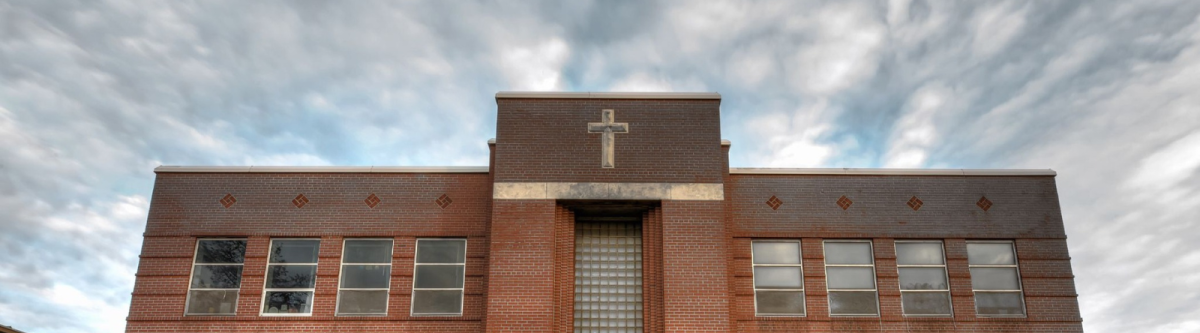
The early history of our parish is very interesting because some members and former members can actually trace their ancestors back to pioneer days. Many roads, streets, buildings, and landmarks of the community still bear the names of these early settlers, who built their homes, reared their families, lived and died in this parish.
As one reads the history of this area a person must realize that the early members of our parish and locality must have been an extremely brave and hardy lot. It may be difficult for present generations to realize that this section was once thought of as the unhealthiest region of Jefferson County, due to plagues, malaria, and other diseases. The area contained swamps, peat bogs, and offensive vapors. But all of that gradually disappeared and certain tracts, after being drained, around 1825, became tillable. Farming on a rather large scale became a prosperous occupation, and it was the main employment of nearly everyone in the early period. Because of the many horses and buggies used by these people it soon became necessary for small businesses such as blacksmith shop, harness makers, etc. to start. Gradually other small businesses were started, general store, millinery for milady’s hats, mills, peddlers, and cobblers. Today this densely populated section has lost its rural atmosphere and residents commute to Louisville, Fort Knox and parts of Indiana.
Saint Andrew Church was one of the first rural churches in Jefferson County outside of Louisville. It was a quaint stone church, situated on a crest overlooking the section known as Wiser’s Valley. It was considered a beautiful landmark in the community, standing on Cardinal Hill off Saint Anthony-Saint Andrew Church Roads, one of the highest points between Iroquois Park and West Point. It was called, “The Church on the Hill.”
Construction of Saint Andrew Church began in 1848 and was completed in 1851. The rough stone used in the construction was quarried from the hills upon which it stood. The parishioners carried the stone to the site, where they were carved into shape, carefully fitted into place, and covered with stucco cement. Nearby trees were felled and shaped for rafters. It took three years to complete because the members had to do most of the work in their spare time. The interior had an arched ceiling, decorated with religious symbols and gilded stars in keeping with the art of by-gone days. The Stations of the Cross were hand painted, written in three languages: English, French and German. The windows were arched at the top and fitted with small panes of glass. Over the bare and undraped altar hung a painting of Saint Andrew, patron saint of the church. The church had a wooden belfry surmounted by a cross while two smaller crosses flanked the belfry tower, but void of any other architectural flourishes.
The church was used for fifty-seven years, but for years it stood as a monument to its builders, a small group of pioneer parishioners.
It is said that Saint Andrew’s was served by, at least, seventy-one different priests, who looked after the spiritual needs of its people. At one time there was a rectory nearby, but usually the priest had to commute from Saint Peter’s and Saint Boniface.
Reverend John B. Peifer built a school on the hill, which at one time had fifty-four students and two teachers.
As is often the case with ethnic groups, there was dissension between the French and the German parishioners as to whether the church was to be of a French or German character, and in 1908 the parish as such, was abandoned. Most of the membership was absorbed by Saint Paul, which was organized in the valley below, where a more commodious and accessible church was built. The Conventual Franciscan Friars were given the care of Saint Paul Church in 1910 with the first Friar/Pastor being Father Marc Maser. Those first Friars lived at Saint Peter Friary, 17th & Garland Streets and commuted by inter-urban to the site on Dixie Highway. This wooden structure served the people until 1958 when the present church was completed while Father Daniel Emerine was Pastor. Ground was broken on January 19, the cornerstone was laid on June 15 and on November 1, 1958, Bishop Charles Maloney blessed the structure. To connect the past and the present stones from old Saint Andrew Church were used in the sanctuary of the present church.
PRESENT SAINT PAUL PARISH
Our parish is located at 6901 Dixie Highway in Pleasure Ridge Park. The Church community is located about halfway between Fort Knox and former city limits of Louisville before the merger of the city and country into Metro Louisville. The geographic area once served by Saint Paul is one of the oldest communities in Jefferson County today.
Other changes or additions in facilities began in 1979 when part of the former convent was converted into meetings rooms and named Hilary Hall. In 1980 a storage room and former classroom was converted into Our Lady of Vocations Chapel in the rear of the Church building. In April 1982 while Father Hilary Gottbrath was Pastor, a dream was fulfilled when construction began on a multi-purpose facility. The school children began using the gym portion of this structure in November 1982 and the project was completed in December 1982.
The smaller size of the present parish is due to the fact that this section of the County saw the first effects of the tremendous growth and development in the late forties and early fifties, necessitating the establishment of additional parishes to serve the Catholic community.
The educational level of our members is extremely varied, from no formal education to Ph.D.’s. But most of our parishioners have higher aspirations for their children.
The occupations vary from highly skilled to unskilled; professional; armed forces; civilian governmental work; industry and services; and some who are self-employed. Most families are well situated and are able to provide a comfortable living, though the parish does have some indigent households.
In reading the history of our present day parish, it is necessary to remember that this small parish of today is, in a sense, the mother-parish, wholly or in part, of at least eight other parishes in the surrounding area of Jefferson County. Through the years as new homes were built the parish boundary lines have changed many times with the creation of new parishes by the Archdiocese. Since the early fifties these have included:
| Saint Lawrence | September 1953 |
| Saint Clement | August 1956 |
| Our Lady Help of Christians | July 1957 |
| Saint Jerome, Fairdale | August 1957 |
| Our Lady of Consolation | January 1960 |
| Saint Polycarp | July 1960 |
| Incarnation Church | December 1966 |
With each change in parish boundaries the character of the parish changed by the subtraction or addition of families, but the area served always became smaller. Many of our present day families have lived in the area about fifty years. What once was an area predominantly either Roman Catholic or Baptist has become more diversified with the addition of other Christian denominations. We are increasingly becoming the People of God.
OUR SCHOOL
Other structures so familiar to the parishioners go back to 1941 when our first school building was constructed. It was enlarged to double the capacity in 1953 under the leadership of Father James Hermes, pastor. The former convent was completed in 1956 and the present Friary in 1960. These buildings were both constructed by the men of the parish. This amounted to a tremendous saving to the parish and aptly is described as a “Labor of Love”.
The Sisters of Mercy came to Saint Paul School in 1910. That year two Sisters had 19 students. By 1953 eleven hundred children were taught by nineteen Sisters. The Sisters of Mercy due to declining numbers in their own ranks had to withdraw from Saint Paul School in the late 1970’s. The parish and school is much smaller than it was in 1953 since our parish community has been carved in whole or in part eight different times as new parishes were formed in southwest Jefferson County.
We feel that our school is an integral part of our parish life. As in the past, our school will continue to enrich our homes, our community, and our democratic way of life. With the religious and educational aspects of our school, we are constantly striving in the pursuit of improving humankind as a whole and each individual as a separate unit to develop their maximum potential as a Catholic, a citizen and as a human being. We feel an obligation to educate our children in the best possible manner, using the latest standards and enable students to accumulate knowledge continuously up-dating their education. Most parents have above average interest in Catholic education for their children. This is demonstrated by their valiant efforts to maintain and support our school by their cooperative attitudes when asked to help both financially and physically,
Therefore, it is essential that we recognize the uniqueness, dignity and worth of each individual in our parish school, regardless of personal differences, attitudes, prejudices, likes and dislikes. We hope to instill true Catholic Christian attitudes and beliefs.